Water · resonance · attention
Suikinkutsu
A hidden water instrument, made for listening.
A listening practice
From drainage
to resonance.
A suikinkutsu began as a practical drainage device beneath the stone wash-basin of a Japanese garden: an inverted vessel received overflow water, and drops falling into the shallow pool inside set its enclosed air cavity ringing. Gardeners refined that accidental music into the “water koto cavern,” a hidden instrument associated with the intimate listening culture of the tea garden. The visitor does not encounter a display object so much as a condition for attention.
That practice nearly disappeared. After declining late in the Edo period and briefly reviving in the Meiji era, the suikinkutsu was largely forgotten by the early Shōwa period. A 1959 survey reportedly found only two surviving examples in Japan. From the 1970s onward, researchers and garden restorers began locating, clearing, documenting, and reinstating vessels that had been abandoned or silted over for generations.
Rediscovery opened the form to renewed use. Contemporary ceramicists, garden makers, and sound artists have carried its essential relation—a drop, a shallow pool, a resonant cavity, and close listening—into restored gardens, galleries, meditation spaces, and purpose-built outdoor installations. This project belongs to that continuing recovery and reinvention: learning from the tradition through consultation, then testing how it may sound within the weather, materials, and cultural conditions of a Pacific coast site.
Beneath the pavilion
A drop enters.
A chamber hears.
A controlled drop falls into a shallow pool inside a buried vessel. The chamber resonates; a raised listening tube brings its quiet sound to a seated listener.
Japanese Canadian garden history
An interrupted
continuity.
Isaburo Kishida designed the Japanese garden at Esquimalt’s Gorge Park in 1907; the Takata family operated its teahouse until 1941. In 1942, more than 22,000 Japanese Canadians were forcibly removed from the BC coast under racist wartime policy. Property and livelihoods were taken, and garden stewardship was among the cultural continuities ruptured.
The renewed Gorge Park garden now carries that history publicly. The project holds this context close: not as a decorative backdrop, but as a reason to proceed through relationships, invitation, and care. Our research has not identified a suikinkutsu on Vancouver Island, nor at UBC’s Nitobe Memorial Garden, one of the most substantial Japanese gardens outside Japan.
The pavilion proposition
Roof, chain,
vessel, ear.
The broad roof is both shelter and water instrument. Rain runs toward a small catchment reservoir recessed into the roof and hidden from ground level. In coastal fog, moisture condensing on the roof’s cool underside can migrate toward the same concealed reservoir, allowing the pavilion to gather water even when there is little direct rainfall.
From that hidden store, a controlled release feeds a redesigned kusari-doi. Its graded links slow and meter the water toward a stone bed, where a clean drop forms before falling into the buried resonant vessel. Heavy overflow returns safely to the ground through a soakaway or site-appropriate drainage system.
The vessel is being developed in conversation with ceramic artists. Two flared listening tubes rise through the pavilion floor to seated ear height, allowing a visitor to listen comfortably while sitting. They carry the vessel’s resonance upward while its source remains out of sight. Their material and exact geometry will be determined through acoustic trials.
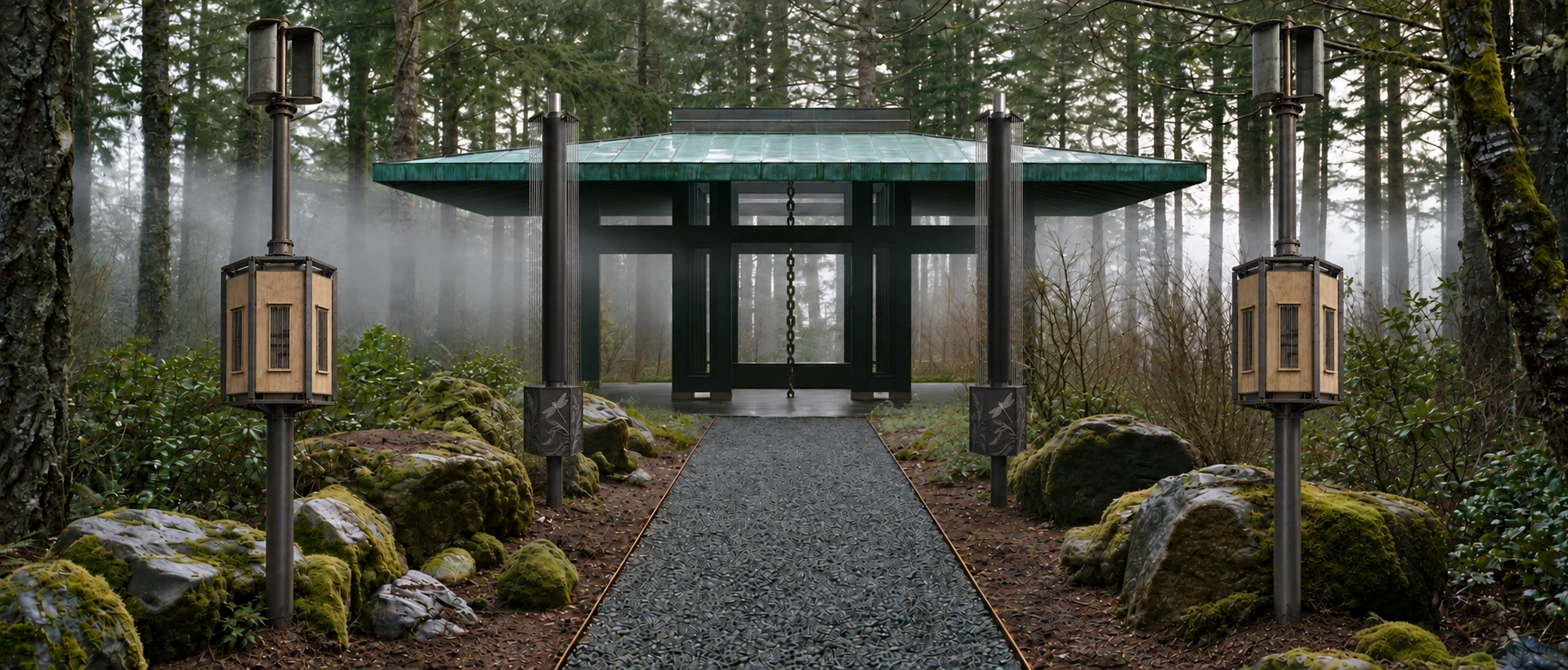
A contemporary coastal convergence
Histories named.
Relationship renewed.
The instrument field brings several inquiries into proximity: Japanese water-listening and rain-guiding practices; European aeolian string traditions; wind flutes and field instruments found across Asia and other regions; and contemporary sound art’s work with chance, systems, and environmental force. The work studies what new relationships can be built in a specific Pacific coast context.
Interactive study
Enter the listening field.
A working model of the coupled wind and water instruments.